 Profile:

The History of Tarot Cards
Since time immemorial, people have longed to know their future. The origins of tarot cards reach far back into the past. Tarot cards gained their popularity in Europe in the mid-15th century, though they first appeared in Europe at the end of the 14th century. The earliest records of tarot cards date to 1367 in Bern, and tarot cards quickly began to spread across all of Europe; in many places they were banned.
Very little is known about how many cards a tarot deck contained at that time. The only available information was published in 1377 in Freiburg, describing a deck of 4 suits with 13 cards each, and mentioning Kings and Queens. Tarot cards consist of arcana — a term meaning “a secret accessible to the inquiring mind”. Today the classic tarot deck consists of 78 arcana.
The arcana are divided into two large groups: the 22 Major Arcana and the 56 Minor Arcana. The Minor Arcana are divided into 4 suits of 14 cards each. It is believed that the Major Arcana were not originally part of the tarot deck and only appeared in 15th-century Italy.
Tarot cards were first documented between 1440 and 1450 in Milan, Ferrara, Florence, and Bologna, when additional trump cards with allegorical illustrations were added to the ordinary four-suit deck. These new cards were called carte da trionfi — triumph cards — and the additional cards, known simply as trionfi, became “trumps” in English.
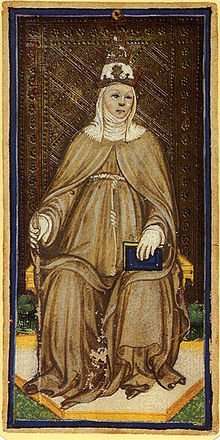
Some sources report that the oldest tarot deck to survive to the present day was created in Italy in the mid-15th century. The Duke of Milan commissioned it as a wedding gift for his wife, Bianca Maria Visconti. The design of this version of the tarot deck was created by the Italian artist Bonifacio Bembo. Drawing on the deck Bembo created, Italo Calvino even wrote a novel titled The Castle of Crossed Destinies.
Enjoying the content? ❤️ ❤️ ❤️ Click here to support the blog →
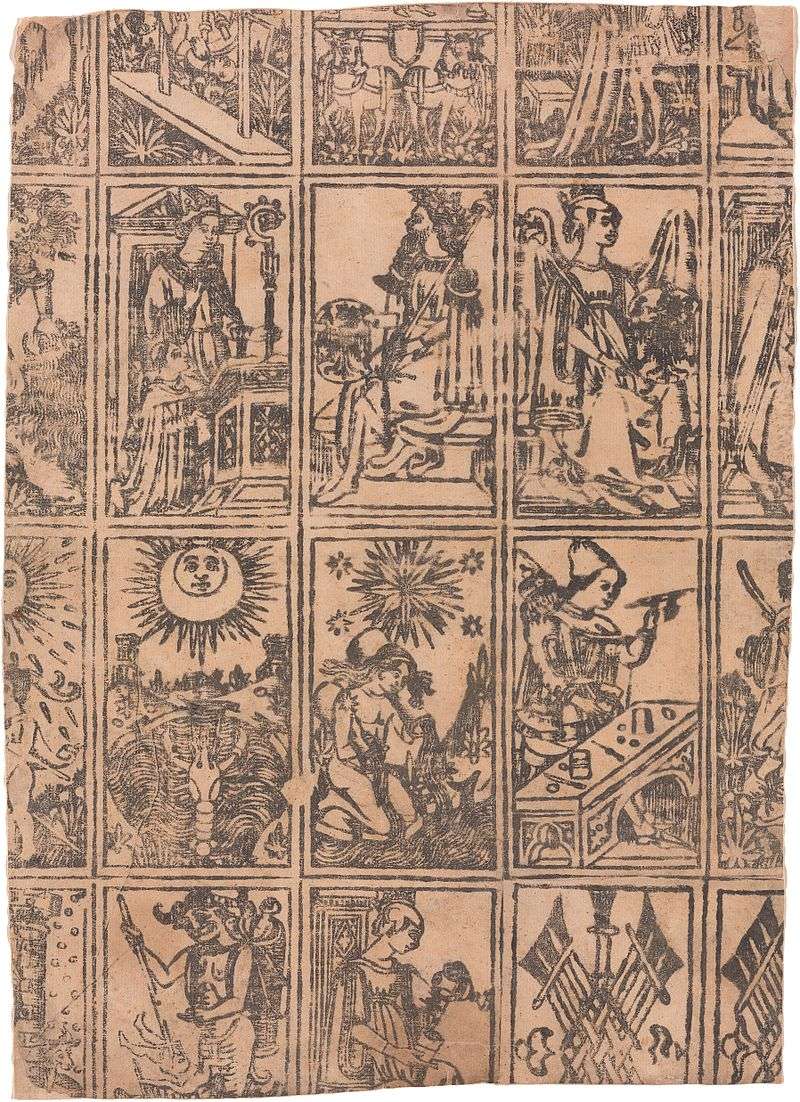
Since in the old days tarot cards were painted by hand, it is believed that the number of tarot decks produced was small. Only after the invention of the printing press did mass production of cards become possible. Tarot spread beyond Italy — first to France and Switzerland — during the Italian Wars. The most prominent version of tarot used in these two countries was the Tarot of Marseilles, of Milanese origin.
Tarot cards were originally created as playing cards, though at first the card game was not very popular. The 18th century brought tarot's greatest revival, during which tarot became one of the most popular card games in Europe, played everywhere except Ireland and Britain, the Iberian Peninsula, and the Ottoman Balkans. French tarot experienced yet another revival beginning in the 1970s, and France has the strongest tarot-playing community. Regional tarot games — often known as tarock, tarok, or tarokk — are widely played in Central Europe within the borders of the former Austro-Hungarian Empire.
The earliest evidence of a tarot deck being used for fortune-telling comes from an anonymous manuscript of around 1750, which documents rudimentary divinatory meanings for the cards of the tarocco Bolognese. The popularization of esoteric tarot began with Antoine Court and Jean-Baptiste Alliette in Paris in the 1780s, using the Tarot of Marseilles. Around 1900, French tarotists abandoned the Tarot of Marseilles in favor of the Tarot Nouveau.
Tarot cards were very popular in many countries in the Middle Ages — from Egypt all the way to India. The tarot system and its symbols were the same everywhere; only the images on the cards changed to match the region and its culture.
The Egyptian version of the tarot featured images of the gods, the Nile, Egypt's rulers, and Egyptian mythology.
The Indian version of the tarot was devoted to the Universe and the connection between the gods and humankind. Some cards related directly to the human soul, the wheel of Samsara, and the afterlife.
Etteilla was the first to publish, around 1789, a tarot deck specifically designed for occult purposes. Following the unfounded belief that such cards derived from the Book of Thoth, Etteilla's tarot featured themes tied to ancient Egypt.
In today's world there are many different variations of tarot cards. The cards come in different sizes and with different imagery, but the symbolic meaning always remains the same.
Enjoying the content? ❤️ ❤️ ❤️ Click here to support the blog →